
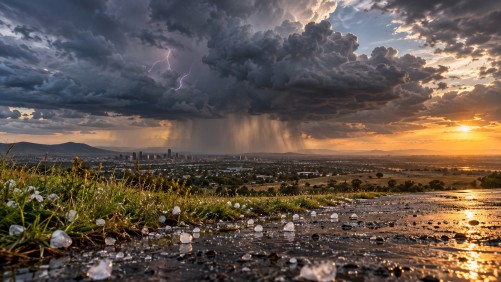
South Africa is bracing for unsettled weather conditions on Wednesday, October 14, 2026, with severe thunderstorms, potential hail, and heatwave risks expected to affect several regions. The provinces of KwaZulu-Natal, Free State, and North West are particularly under alert, with weather warnings issued to residents.
The South African Weather Service has placed a Yellow Level 2 warning for severe thunderstorms across much of KwaZulu-Natal. Additionally, a heatwave advisory remains active for the north-western parts of the region until Thursday, prompting residents to take necessary precautions.
In KwaZulu-Natal, morning fog is anticipated over the far western interior, followed by partly cloudy skies and warm to hot temperatures. Scattered showers and thunderstorms are forecast in the south-west, while isolated showers are expected elsewhere, excluding the north-east. Coastal winds will shift from southerly to south-westerly and then to north-easterly throughout the day. The UVB sunburn index is projected to be high, indicating a need for sun protection.
Durban is predicted to experience partly cloudy skies with isolated showers and thunderstorms. Light winds are expected to transition towards the north-east by late morning, with temperatures ranging between 21°C and 27°C, and a high UVB sunburn risk.
In the Free State, conditions are expected to be partly cloudy, windy, and warm to hot, with isolated showers and thunderstorms. The extreme north-west may see scattered storms, although specific temperature forecasts for Bloemfontein remain unclear. Residents are urged to stay informed of local weather updates and exercise caution during thunderstorms.
The North West province is also set to experience partly cloudy and warm to hot weather, with isolated showers and thunderstorms. Scattered storms could occur in the extreme western areas. In Mahikeng, temperatures are predicted to range from 17°C to 31°C under partly cloudy skies with isolated showers and thunderstorms.
Authorities recommend that residents in affected areas monitor weather reports closely, take appropriate precautions during severe thunderstorms, and protect themselves from strong sunshine and high temperatures. This includes staying indoors during storms and wearing sunscreen or protective clothing when outdoors.